A Survey of Personalized Large Language Models: Progress and Future Directions
A Survey of Personalized Large Language Models: Progress and Future Directions, Liu et al., arXiv’25
This is a survey paper for the state of PLLMs in 2025. It’s a useful follow-up from last week’s LaMP paper, because research into PLLMs has exploded in the past two years, and to be honest it’s hard to keep abreast of the developments.
…boy, that escalated quickly.
This is a tricky paper to summarize, because it is primarily an exhaustive and detail-heavy recap of the past few years of PLLM research, but I’ll do my best to keep it brief where the authors can’t.
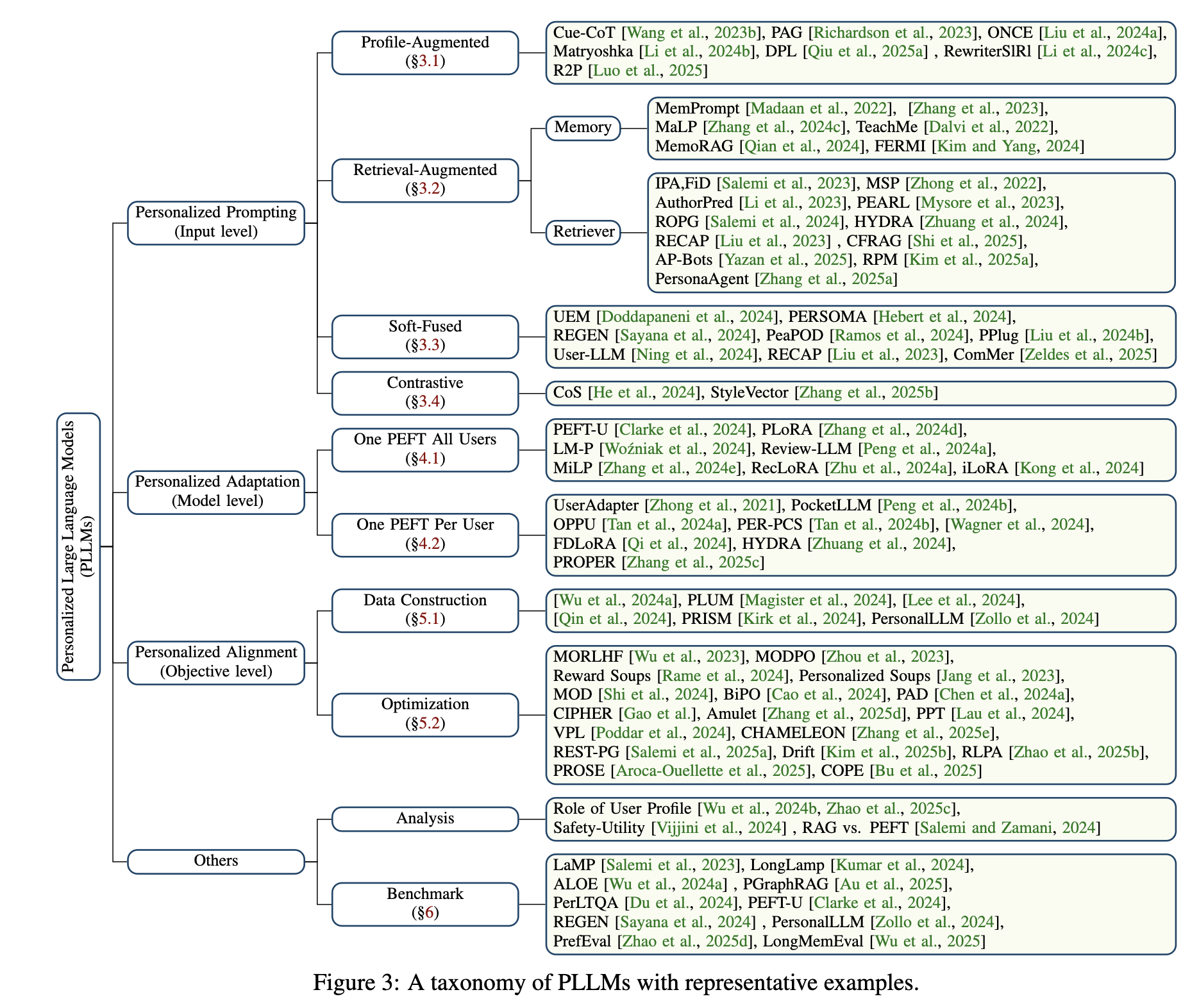
The largest contribution in this paper is an attempt to categorize PLLM research across a number of different axes: personalized data type, query type, downstream task type, and ‘personalization approach’. The latter is a genuinely new framing, but all of the categories are worth reading. I particularly enjoyed the section on personalized data:
The personalized data C may encapsulate information about the user’s preferences, history, context, and other user-specific attributes. These can include profile/relationship, historical dialogues, historical content, and predefined human preferences…
Each of these subcategories is expanded on at length, and it’s pretty easy to see:
- how each category is clearly useful in personalization
- why each category may need to be handled separately from all other categories
- Profile/Relationship User profile, including attributes (e.g., name, gender, occupation), and relationships (e.g., friends, family members), such as Ci = {A, 18, student, friends:{B, C, D} … }
- Historical Interactions Includes historical interactions, preferences, ratings from user ui. For example, Ci = {The Lord of the Rings : 5, Interstellar : 3 … }.
- Pre-defined Human Preference: Define a set S = {dk}K k=1 containing of K preference dimensions such as “Helpfulness”. Choose various combinations of these dimensions, form individual preferences, and incorporate them as the instruction. For example, a preference prompt could be “Be harmless and helpful”.
Thinking through the different structures of personalization data, we can imagine how using two different data types will require drastically different approaches, even if they share the same query type. We won’t be able to take the same approach towards movie recommendations if our datasets are ‘user browser history’ vs ‘user Netflix ratings’!
Also valuable is the categorization of downstream tasks, which now span generation, recommendation, and classification. Eagle-eyed readers may note that recommendation is now treated as a separate field from the generation & classification categories listed within LaMP, and I think this is a sensible change given the existence of recommendation engines as their own field of study with extensive pre-existing approaches that seem applicable.
Probably the boldest and most controversial taxonomy suggestion, though, is a taxonomy based on ‘technical perspectives’. Under this framing personalization approaches may be categorized according to the level at which the personalization occurs: the input level (‘personalized prompting’), the model level (‘personalized adaptation’), or the objective level (‘personalized alignment’). This actually addresses one of the major critiques I had with the LaMP paper, where approaches were only judged on their efficacy and not on feasibility of actual implementation - specifically the highly-effective Fusion-in-Decoder approach isn’t applicable to many models.
Personalization Levels
The authors split up personalization approaches into three levels: input, model, and objective, according to the layer at which personalization is applied to the PLLM:
We propose a taxonomy (as illustrated in Figure 2 and Figure 3) from technical perspectives (i.e., regarding the personalization operation P), categorizing the methods for Personalized Large Language Models (PLLMs) into three major levels: (1) Input level: Personalized Prompting focuses on handling user-specific data outside the LLM and injecting it into the model (Section 3). (2) Model level: Personalized Adaptation emphasizes designing a framework to efficiently fine-tune or adapt model parameters for personalization (Section 4). (3) Objective Level: Personalized Alignment aims to refine model behavior to align with user preferences effectively (Section 5).
The authors exhaustively categorize the current state of PLLM research according to this new taxonomy, but honestly my biggest takeaway was simply: One of These Things Is Not Like the Other:
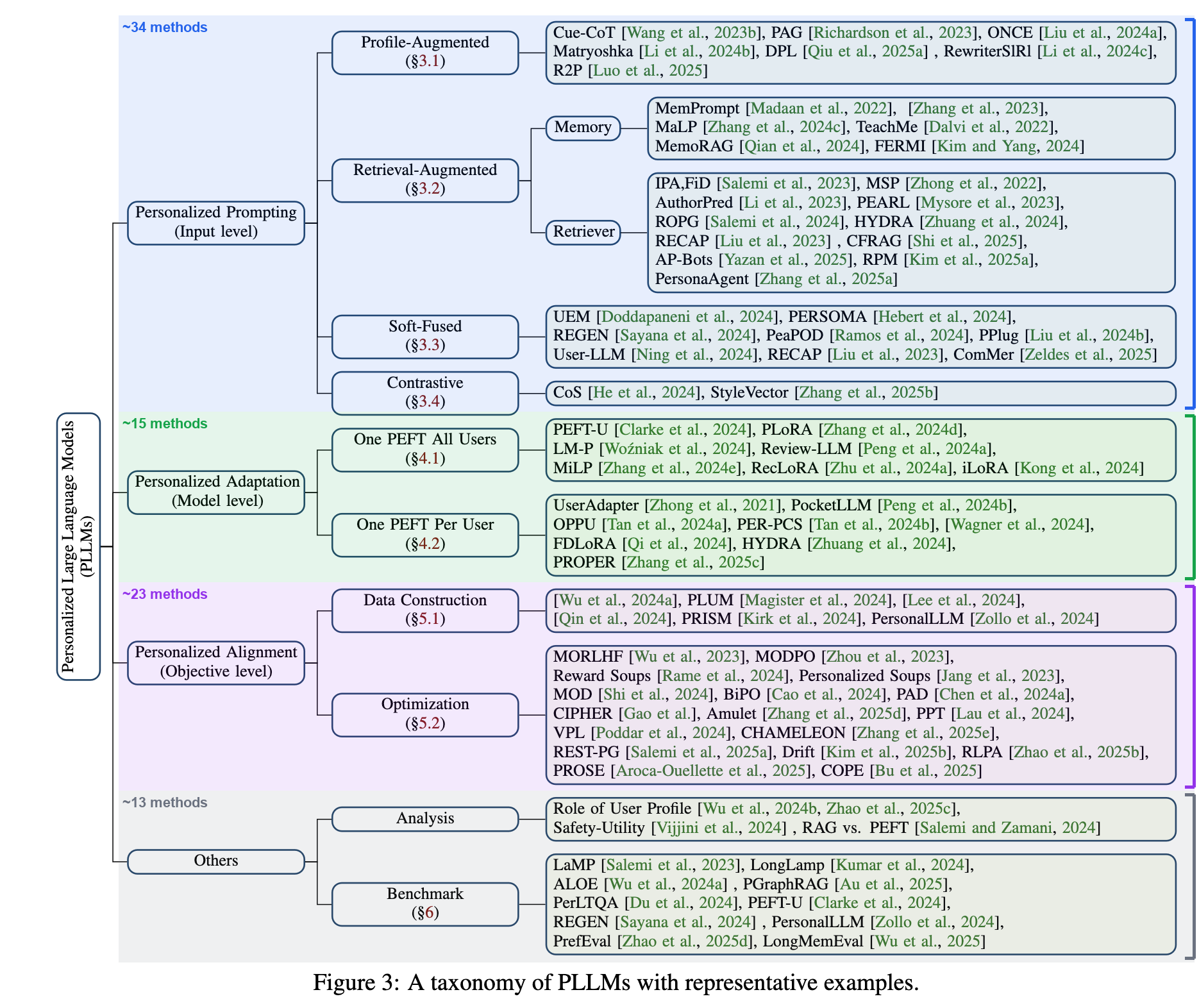
Research seems primarily focused on the input level, and I think that’s…reasonable? We have a broad body of input-layer modification research already (RAG, memory) which seems to map well to the personalization space. Model layer approaches may be effective but practicality is questionable today - spending significant time fine-tuning models is questionable when the underlying models are rapidly changing underneath you. Alignment optimization is intriguing but the research is early: as the authors point out, we don’t even have good real-world data here yet.
Closed-Model Guide to Personalization
I wanted to provide a practitioner’s guide to personalization of a closed-model, but the real takeaway is that you need to:
- Understand your personalization data
- Understand what tasks you are attempting to personalize
- Pick an appropriate strategy accordingly
Here’s an infodump of approaches you should be aware of:
Profile-Augmented Prompting: Summarization of User Preferences and Profiles
Profile-augmented prompting explicitly utilizes summarized user preferences and profiles in natural language to augment LLMs’ input at the token level…The summarizer model is typically distinct from the base LLM (generator)
Approaches: Cue-CoT, PAG, ONCE, DPL, Matryoshka
Retrieval-Augmented Prompting
Retrieval-augmented prompting excels at extracting the most relevant records from user data to enhance PLLMs…Due to the complexity and volume of user data, many methods use an additional memory for more effective retrieval.
Memory Construction: MemPrompt, TeachMe, MaLP, FERMI, LD-Agent, MemoRAG, PRIME
Memory Retrieval: PEARL, HYDRA, ROPG, RPM
Retrievers: sparse (BM25), dense (Faiss, Contriever)
Open or Closed?
One thing this survey doesn’t attempt to do is answer: which approaches towards personalization have been found effective, and in what areas? I’m left wondering about the efficacy of open- vs closed-model approaches. LaMP found that for certain task types FiD significantly outperformed IPA, and I’d argue these remain the predominant approaches towards personalization today. However, FiD comes at significant cost and complexity, and causes adopters to lag behind new model releases.
Put more simply: if we can optimize a model’s personalization performance with a fine-tuning approach, but in doing we slow down our adoption of an improved underlying model, was that fine-tuning still worth it? That’s not a question with an easy answer, but anecdotally it seems like fine-tuning has become less prevalent across the applied AI ecosystem. It might be worth noting that some of the frontier model providers (OpenAI) are even phasing out their fine-tuning products. Prompt-level approaches towards personalization and memory have become the norm, and may be banking on improved underlying model performance to drive performance gains in the future.
Edge Computing
Let’s look at some recurrent themes:
- Fine-tuning / adaptation approaches (e.g. FiD) have been found highly effective for certain personalization tasks.
- Per-user variants (one PEFT per user) are expensive and impractical, as cost and storage scale per-user.
- Shared variants (one PEFT for all users) are scalable but achieve worse personalization performance.
How can we resolve this tension? I’m increasingly of the opinion that the answer is to move personalization to the edge, whether through small models or soft-fused input prompting.
A key challenge in edge computing is efficiently updating models on resource-constrained devices (e.g., phones), where storage and computational resources are limited. For example, fine-tuning offers deeper personalization but is resource-intensive and hard to scale, especially in real-time applications. Balancing resources with personalization needs is important. A potential solution is to build personalized small models for edge devices, using techniques like quantization and distillation
Worth keeping an eye on.